Deck & Seamanship
Disabled Vessel in a Beam Wind: Where to Start Running Tow Lines
Exam reference: D025DG (the label exam questions use for this figure)
What the figure shows
A grey vessel seen from above with her bow pointing left. Four blue letters sit off the bow: A above, C straight ahead in line with the bow, D below, and B farther out to the left. The questions say the wind is on her starboard beam.
How to read it
- With the bow pointing left, her starboard side is the top of the drawing, so the wind blows from the top toward the bottom.
- That makes A the windward position, D the leeward position, and C dead ahead of the bow.
- Before choosing, compare your vessel's leeway with hers: equal leeway and greater leeway lead to different keyed positions.
What exam questions ask
- Where to start running lines when you make more leeway than the casualty. Start from the windward side, position A, because you will drift down toward her faster than she drifts away.
- Where to start when both vessels make the same leeway. Drift alone will not change your relative positions, and the official key for this version is position C, ahead of her bow.
Common mistakes
- Taking the leeward position when you make more leeway. You would drift away from her faster than she drifts and could not hold station to pass lines.
Related figures
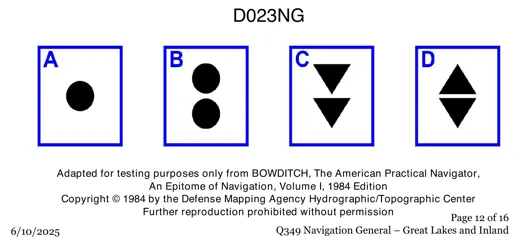 Deck & SeamanshipBuoy Topmarks: Spheres and Paired Cones
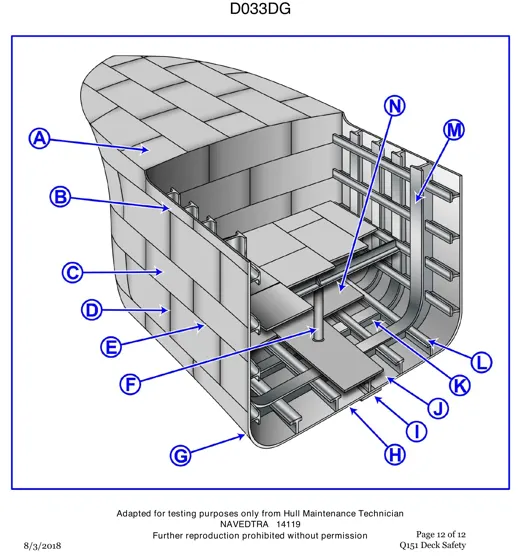 Deck & SeamanshipShip Bow Structure Cutaway, Parts A to N
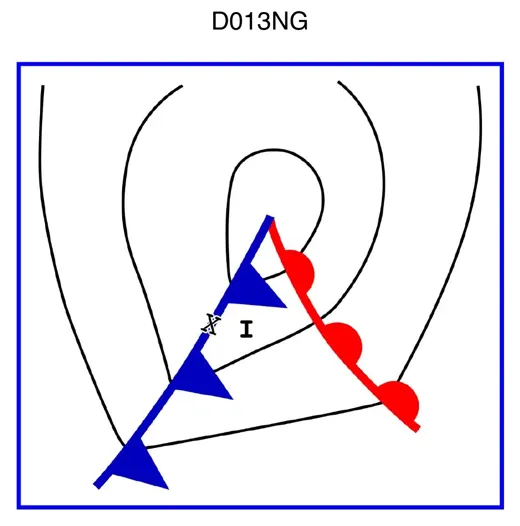 Deck & SeamanshipWeather Map: Warm Sector Near a Cold Front
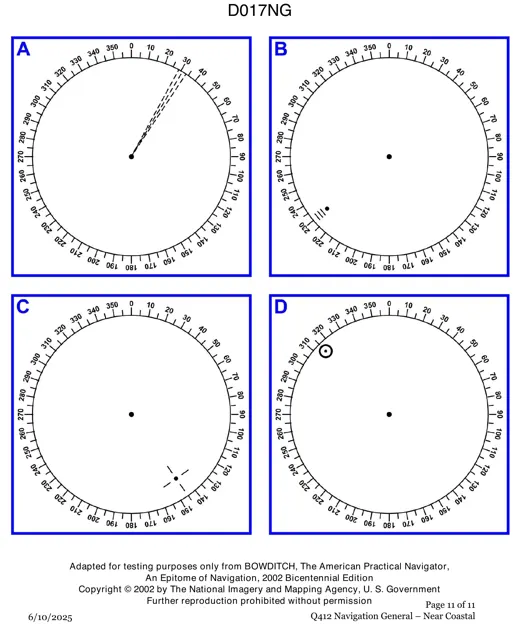 Navigation & ChartsRadar Screens: Spotting a Racon Response
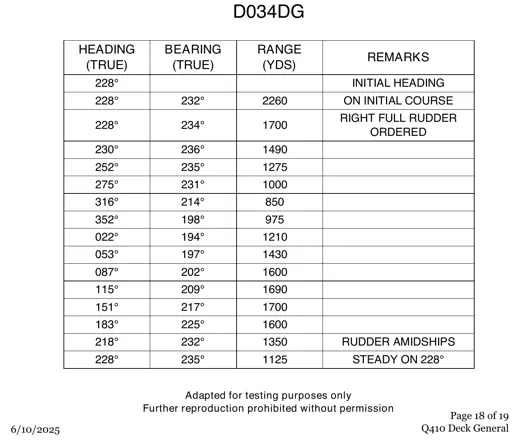 Navigation & ChartsTurning Trial Table: Advance at 45 Degrees
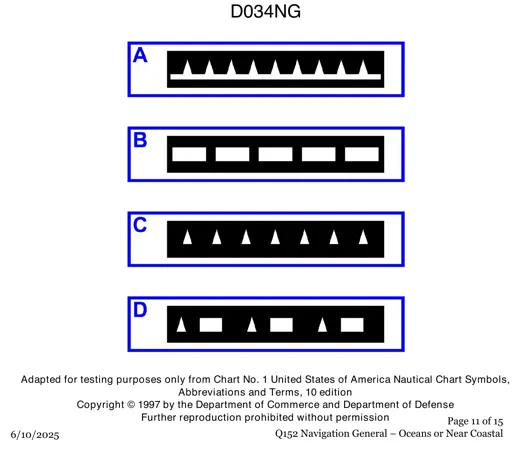 Navigation & ChartsLight Characteristics: Occulting vs Flashing