Navigation & Charts
Light Characteristic Patterns: Occulting, Flashing, Fixed and Flashing
Exam reference: D034NG (the label exam questions use for this figure)
What the figure shows
Four black bars, lettered A to D, each draw a light pattern in white. A has a steady white baseline with small peaks rising above it. B has long white rectangles split by short black gaps, C has short peaks with long dark spaces between them, and D alternates peaks with rectangles.
How to read it
- White is light and black is dark, so read each bar left to right as the light turning on and off.
- Compare how long the light shows against how long it is dark in each pattern.
- Look for a continuous baseline under the peaks: that steady light with flashes on top is what separates A from the others.
What exam questions ask
- Which pattern is occulting: a light that is on longer than it is off, drawn as long white periods broken by short dark intervals.
- Which pattern is fixed and flashing: a steady light that is made brighter at intervals by a flash, drawn as a continuous line with peaks above it.
Common mistakes
- Mixing up occulting and flashing. Short flashes with long dark intervals is a flashing light; occulting is the reverse, with light lasting longer than the dark.
- Picking a pattern of flashes with no steady light underneath for fixed and flashing. Without a continuous baseline it is not fixed and flashing.
Related figures
 Navigation & ChartsTurning Trial Table: Advance at 45 Degrees
 Navigation & ChartsShip Weather Report Form B-80: Coded Groups
 Navigation & ChartsSpar Buoy With Two Black Sphere Topmark
 Navigation & ChartsRadar Screens: Spotting a Racon Response
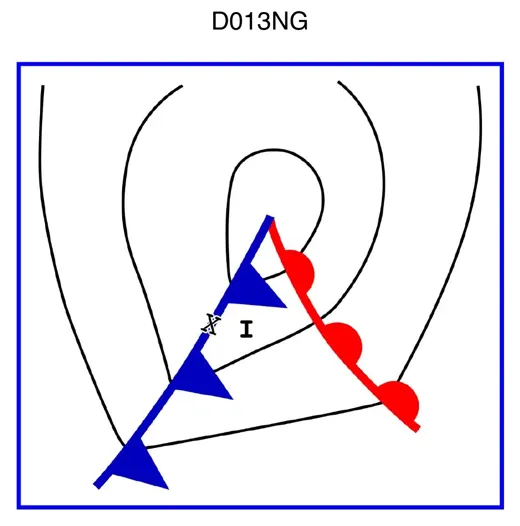 Deck & SeamanshipWeather Map: Warm Sector Near a Cold Front
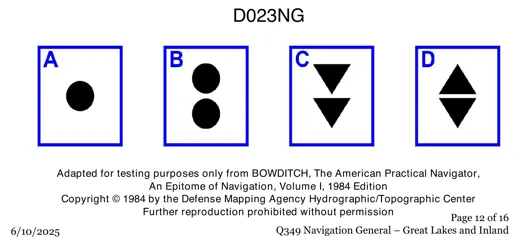 Deck & SeamanshipBuoy Topmarks: Spheres and Paired Cones