Rules of the Road
Crossing Vessels A and B: Doubt, Reply and Backing Signals
Exam reference: D042RR (the label exam questions use for this figure)
What the figure shows
A top-down drawing of two vessels on crossing courses. Vessel A is at the upper left heading right across the page, and vessel B is at the lower right heading up the page. Each has a black arrow showing her direction.
How to read it
- Fix each vessel's position and heading: A at upper left heading right, B at lower right heading up.
- Check whether the question is International only, Inland only or both, since the reply rules differ.
What exam questions ask
- What B does when A sounds two short blasts and B doubts A is doing enough to avoid collision: sound five or more short and rapid blasts, the doubt signal.
- What B sounds under International rules after A sounds one short blast. No reply is required; International signals report a vessel's own actions and are not answered.
- What three short blasts from A mean: A is backing her engines, a meaning that stays the same in any encounter.
Common mistakes
- Answering an International signal with a matching one. B sounds a signal only if she herself alters course or uses astern propulsion.
- Reading three short blasts as doubt. The doubt signal is at least five short and rapid blasts.
- Turning left and speeding up when in doubt. Signal the doubt first instead of making an independent maneuver.
Related figures
 Rules of the RoadMeeting on a River: Lights Seen Ahead
 Rules of the RoadNight Lights: Two White and One Green
 Rules of the RoadCrossing: Power Vessel vs Sailing Vessel
 Rules of the RoadTowing Vessel Lights: Three White Masthead
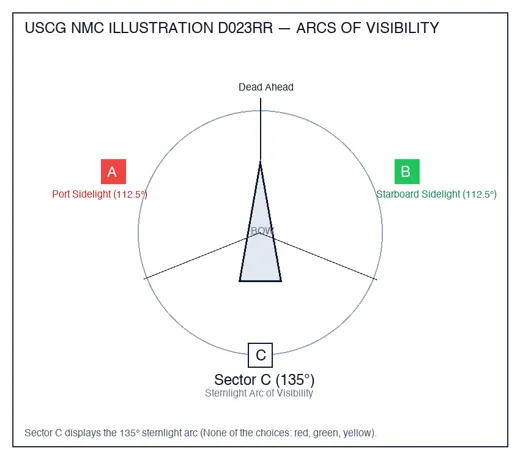 Rules of the RoadArcs of Visibility: The 135 Degree Stern Arc
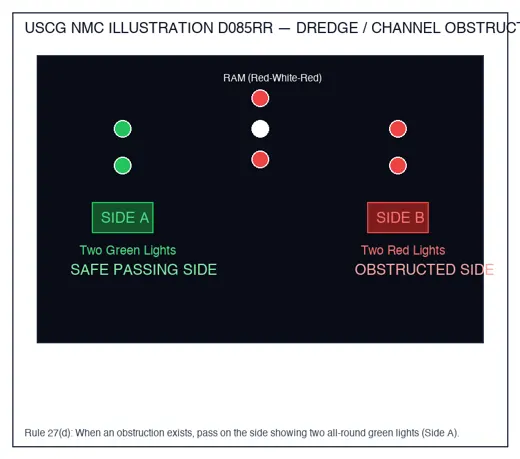 Rules of the RoadDredge Lights at Night: Which Side to Pass