Quick answer: To get an OUPV (six-pack) license you need 360 days of sea time (90 of them offshore for near coastal, plus 90 days in the past 7 years), to be 18 or older, a U.S. citizen (with one exception), a medical certificate, a drug test, first aid and CPR, and a passed Coast Guard exam or approved course. Coast Guard fees total $240.
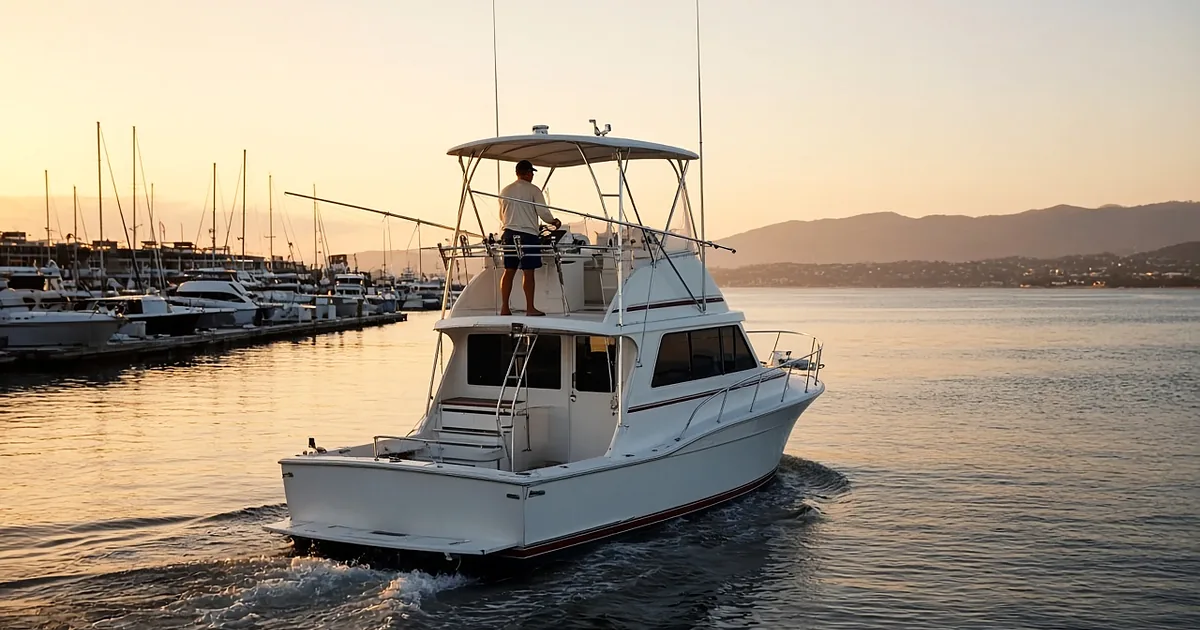
Six passengers. That's the ceiling, and it's where the nickname comes from. A charter captain with a six-pack license can take a family of six fishing for the day on an uninspected boat under 100 gross register tons. The seventh paying passenger needs a different license and a different boat.
Officially it's an endorsement as Operator of Uninspected Passenger Vessels, OUPV, under 46 CFR 11.467. The National Maritime Center (NMC) publishes an evaluation checklist for it (MCP-FM-NMC5-31, dated Sept. 15, 2025). This guide follows that checklist.
The checklist
- Age: 18 or older
- Citizenship: U.S. citizen, or a non-citizen applying for an OUPV limited to vessels not documented under U.S. law
- Sea time: 360 days; 90 on ocean, near-coastal or Great Lakes waters for near coastal; 90 days in the past 7 years
- Medical certificate, or approval for one
- Drug test results dated not more than 185 days before you apply
- First aid within the past year and valid CPR (a valid STCW Basic Training certificate covers the first-aid part; CPR needs its own current card)
- Exam passed, or an approved course certificate in its place (46 CFR 10.402)
- TWIC and forms CG-719B, CG-719S (for sea service), 719P and 719C if applicable
- Fees paid at pay.gov
The checklist also says OUPV is not an STCW capacity, so it doesn't cover international voyages that require STCW. And a Spanish speaker who doesn't speak English may get an OUPV restricted to U.S. navigable waters near Puerto Rico.
Pick your route first
The route decides where you can run and what sea time you need.
| Route | Where you can operate | Sea time (46 CFR 11.467) |
|---|
| Near coastal | Up to 100 miles offshore, plus Great Lakes and inland | 12 months, at least 3 on ocean or near-coastal waters |
|---|
| Great Lakes and inland | Great Lakes and inland | 12 months, at least 3 on the Great Lakes |
|---|
| Inland | Inland waters except the Great Lakes | 12 months |
|---|
Our view: if any of your time is offshore and you can document it, go near coastal. It covers everything inland does and more. Inland-only makes sense if you'll only ever run a lake or river.
The regulation also allows limited OUPV endorsements for people working at camps, yacht clubs, schools and marinas, and restricted endorsements for specific inland waters approved by the local Officer in Charge, Marine Inspection. Those have their own rules.
Sea time: 360 days, and the 90 that trip people up
The NMC checklist converts the regulation's 12 months to 360 days, because NMC counts a month as 30 days.
| Route | Total | Of which |
|---|
| Near coastal | 360 days | 90 on ocean, near-coastal or Great Lakes waters |
|---|
| Great Lakes | 360 days | 90 on Great Lakes waters |
|---|
| Inland | 360 days | None required |
|---|
| All routes, recency | 90 days | Within the past 7 years, any tonnage |
|---|
On boats under 100 GRT, NMC credits a full day for 4 or more hours underway, the minimum 46 CFR 10.232 allows for these vessels. Under 4 hours earns nothing. Service counts from age 16 and never expires.
One caution on recency: the 7-year window comes from NMC's OUPV checklist. The regulation's own text, 46 CFR 11.201(c)(1), asks for at least 3 months of service on vessels of appropriate tonnage within the 3 years before you apply (7 years for uniformed-services time). If your recent days are thin, ask NMC which rule it will apply to your application before you file.
Worked example: an applicant has 410 logged days, all on inland waters, the last of them in 2017. She has plenty of total time, but none of it is near coastal and none falls in the past 7 years. She qualifies for nothing yet. Ninety days on the water before applying fixes recency and opens inland; 90 offshore days would open near coastal.
How you document each day matters as much as having it. Read our guide to filling out the CG-719S sea service form before you collect signatures.
The exam, or an approved course
You either pass the Coast Guard exam or present a course completion certificate in lieu of it, under 46 CFR 10.402. Either way you need the material: Rules of the Road, seamanship, safety equipment, aids to navigation, weather and chart work.
The Rules of the Road section is where most people spend their study time, because lights, shapes and sound signals take memorization. Our lights, shapes and sound signals trainer drills them. For full practice, use the OUPV near coastal practice test or the Great Lakes and inland OUPV questions.
What it costs: $240 to the Coast Guard, plus the rest
46 CFR 10.219 sets user fees. An original lower-level officer endorsement (lower level means vessels under 1,600 GRT, which includes OUPV):
| Coast Guard fee | Amount | When to pay |
|---|
| Evaluation | $100 | With the application |
|---|
| Examination | $95 | Before the first exam section |
|---|
| Issuance | $45 | Before the credential is issued |
|---|
| Total | $240 | Or all at once when you apply |
|---|
The regulation says fees must be the exact amount and paid electronically as the Coast Guard specifies. If you take an approved course instead of the Coast Guard exam, check with NMC which fees apply to your application. Course tuition, the medical exam, drug test, first aid and CPR, and TWIC are all separate costs.
Applying, step by step
From NMC's Apply for Merchant Mariner Credential page:
- Apply for your TWIC and complete CG-719B, CG-719S, 719P and 719C if applicable. Use NMC's checklist page to pick the credential.
- Gather your other sea-service documents and training certificates.
- Pay at pay.gov and apply through Navita, NMC's online system.
Under 46 CFR 10.225, an original application also includes the oath, consent for a National Driver Register check, and your drug test, sea service and medical documents. If NMC needs more, it sends a request for additional information, and you reply with a single combined PDF.
Once issued, a Merchant Mariner Credential is valid for 5 years (46 CFR 10.205). You can renew any time while it's valid or within a year after it expires (10.227). For a renewal with no other changes, the Coast Guard may post-date the new credential up to 8 months. Under 10.301, mariners not on STCW vessels get a medical certificate valid for up to 5 years.
Mistakes that slow OUPV applications
- No recent time. 90 days in the past 7 years is required even if you have thousands of older days.
- Vague waters. Near-coastal credit needs near-coastal waters clearly described on the sea service form.
- Short trips. Under 4 hours on a small boat is zero.
- Self-signed forms on someone else's boat. The owner, operator or another master signs.
- Stale first aid. It must be within the past year.
- Paying the wrong amount. Fees must be exact.
What to do next
- Tally your days by route and check the 90-day recency rule.
- Book the medical exam, drug test, and first aid and CPR.
- Take a full practice exam for your route.
- Thinking bigger? You can compare OUPV with a Master license, see what the Master 100 exam adds, and keep our plain-English definitions of GRT, COI and TWIC handy.
Frequently asked questions
How much sea time do I need for an OUPV license?
Twelve months under 46 CFR 11.467, which NMC counts as 360 days. Near coastal needs 90 of those on ocean, near-coastal or Great Lakes waters. You also need 90 days in the past 7 years.
What is the difference between OUPV near coastal and inland?
Near coastal allows operation up to 100 miles offshore plus the Great Lakes and inland waters, and needs 3 months of offshore service. Inland covers inland waters except the Great Lakes and needs no offshore time.
How old do you have to be to get an OUPV license?
Eighteen. Sea time can count from age 16.
Can a non-citizen get an OUPV license?
The NMC checklist says an OUPV limited to vessels not documented under U.S. law may be issued to non-citizens.
What does a day of sea time mean on a small boat?
On vessels under 100 GRT, at least 4 hours of service. Less earns no credit.
How much does an OUPV license cost from the Coast Guard?
46 CFR 10.219 lists $100 evaluation, $95 examination and $45 issuance for an original lower-level officer endorsement: $240. Training, medical, drug testing and TWIC are extra.
How we checked this
Requirements come from 46 CFR 11.467, NMC's OUPV checklist (Sept. 15, 2025), NMC's sea-service guide and application page, and 46 CFR Part 10, read on November 15, 2026. The $240 total and the worked example are our application of those rules.
- 46 CFR 11.467: https://www.ecfr.gov/current/title-46/chapter-I/subchapter-B/part-11/subpart-D/section-11.467
- NMC, OUPV checklist MCP-FM-NMC5-31: https://www.dco.uscg.mil/Portals/9/NMC/pdfs/checklists/mcp_fm_nmc5_31_web.pdf
- NMC, Crediting Sea Service: https://www.dco.uscg.mil/Portals/9/NMC/pdfs/professional_qualifications/crediting_sea_service.pdf
- NMC, Apply for Merchant Mariner Credential: https://www.dco.uscg.mil/nmc/merchant_mariner_credential/
- 46 CFR Part 10 (10.205, 10.219, 10.225, 10.227, 10.232, 10.301): https://www.ecfr.gov/current/title-46/chapter-I/subchapter-B/part-10
Mariner IQ is not affiliated with the U.S. Coast Guard or the National Maritime Center. This guide explains public regulations and NMC instructions; it is not legal advice. Spot an error? Email hello@mariner-iq.com.